


Blog
Top 5 PIM Systems in 2026: A Practical Comparison Guide
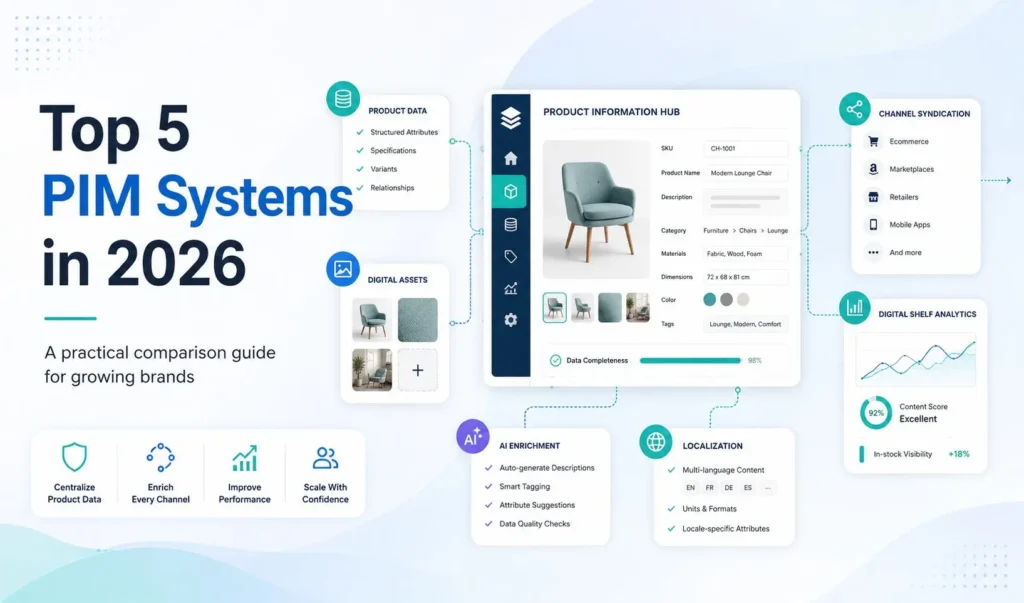
Choosing the right Product Information Management system in 2026 is no longer just about finding a place to store product data.
For growing brands, a PIM now needs to support product content creation, digital assets, localization, retailer-specific exports, AI enrichment, and increasingly, digital shelf performance tracking.
In this guide, we compare five leading PIM systems: Brandquad, Salsify, Inriver, Akeneo, and Plytix. Each platform fits a different type of business. Plytix is often a good first PIM for small teams. Salsify is strong for large enterprise syndication. Inriver fits complex B2B catalogs. Akeneo is popular for composable commerce. Brandquad is built for growing local, regional, and global brands that need a practical PIM today and room to scale into a full PXM ecosystem tomorrow.
The best PIM system is not always the biggest one. It is the one your team can implement, use, localize, and grow with.
What is a PIM system?
A Product Information Management system, or PIM, is software that centralizes and manages the product data companies need to market, sell, and distribute their products across channels.
A PIM stores and organizes product information such as product names, SKUs, descriptions, attributes, technical specifications, ingredients, dimensions, certificates, logistics data, translations, product categories, retailer-specific content, SEO data, and linked digital assets.
In practice, a PIM helps companies replace scattered spreadsheets, folders, emails, and outdated internal systems with one structured source of truth.
Instead of asking, “Which file is the latest?” or “Who sent the correct product description to the retailer?”, teams can manage all approved product information in one place and distribute it in the right format.
Why PIM matters more in 2026
Product content has become a direct driver of sales performance.
In e-commerce, shoppers do not interact with a physical product first. They interact with a product card. That product card must answer their questions, build trust, show the right images, contain the right attributes, and meet the requirements of the retailer or marketplace.
If product content is incomplete or inconsistent, the consequences are immediate. Products become harder to find in search. Conversion rates drop. Customers abandon carts. Return rates increase. Retailers reject or delay listings. Local teams waste time fixing errors manually. Brand consistency suffers.
This is no longer only an enterprise problem. Regional and local brands face the same issue as soon as they start selling through multiple channels.
A brand does not need to be global to need a PIM. It only needs enough product complexity for spreadsheets to become a risk.
If a company sells through several retailers, manages several product categories, works with product assets, supports multiple languages, or updates product content regularly, a PIM can quickly become essential.
What to look for in a PIM system in 2026
Before comparing vendors, define what kind of buyer you are.
Are you replacing spreadsheets for the first time? Are you supporting local retailers and distributors? Are you managing several languages? Are you distributing product data to marketplaces? Are you connecting product content with images, certificates, and videos? Are you trying to understand how your products perform on the digital shelf?
The right PIM depends on the answers.
Here are the most important criteria to evaluate.
Ease of implementation
A PIM should not take years to become useful.
Implementation speed matters because product, e-commerce, marketing, and sales teams need value quickly. If the system is too complex, local teams will return to spreadsheets and the PIM will become another unused corporate tool.
Look for a system that lets business users configure attributes, categories, workflows, exports, and user roles without needing development for every change.
Data model flexibility
A good PIM must support the way your business actually works.
This includes product families, variants, bundles, packaging levels, market-specific attributes, local language fields, retailer-specific fields, certificates, documents, and product-to-asset relationships.
The system should not force your catalog into a rigid structure that creates workarounds later.
Localization and local channel support
Localization is one of the most underestimated parts of PIM selection.
Many global PIM platforms look strong during a tender. They have powerful architecture, polished enterprise messaging, and impressive global references. But after implementation, regional teams may still struggle to adapt product content to local retailers, local languages, and local channel formats.
That is where many PIM projects lose momentum.
A strong PIM must support both global governance and local execution. A good global PIM must also be a good local PIM.
DAM and asset management
Product data and digital assets belong together.
If a product card says one thing but the image shows another, the customer sees inconsistency. If the retailer receives an outdated packshot, the brand loses control. If a local distributor uses an old certificate or manual, the company faces operational or compliance risk.
That is why modern PIM buyers should look for strong DAM capabilities or a native connection between PIM and DAM.
Product data distribution
A PIM must make product content usable outside the system.
This can include API integrations, retailer export channels, Excel, CSV, XML and JSON exports, GDSN, SFTP, public catalogs, distributor portals, marketplace feeds, Shopify or Magento connectors.
The important point is not only whether export is possible. It is whether business users can send the right content to the right channel without rebuilding files manually every time.
AI enrichment
AI is now a baseline expectation in PIM.
Useful AI capabilities include generating product descriptions, translating attributes, extracting attributes from documents, suggesting keywords, creating SEO data, classifying products, checking content quality, and identifying missing or inconsistent information.
But AI only creates value when it is connected to structured product data and real workflows. A generic AI text box is not enough. The best PIM systems use AI to reduce manual work inside the product content process.
Digital Shelf Analytics
A PIM stores the content you expect to publish. Digital Shelf Analytics shows what actually appears online.
This is critical because retailers and marketplaces may change titles, miss images, reject attributes, display outdated content, run unexpected promotions, or show a product as out of stock.
When DSA is connected with PIM, the team can close the loop: identify a problem, fix the product card, and redistribute corrected content.
This is the difference between simply monitoring the digital shelf and actively improving it.
Top 5 PIM systems in 2026
1. Brandquad: best PIM for growing brands that need structure, localization, and room to scale
Best for: local, regional, and global brands that are ready to manage product data professionally and want a PIM that can start simple, support localization, and scale into a full PXM ecosystem.
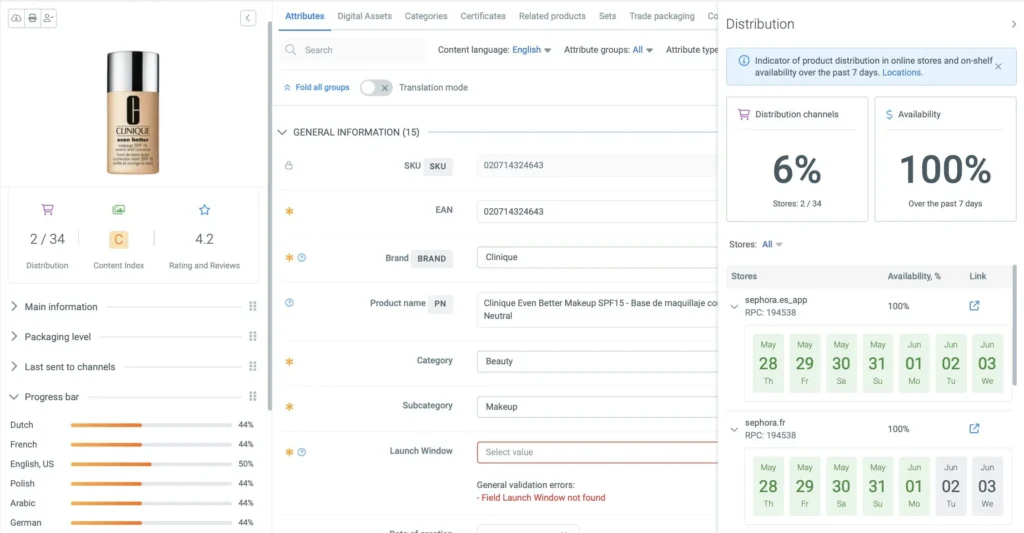
Brandquad is a Product Experience Management platform that combines PIM, DAM, product data distribution, public catalogs, AI enrichment, workflows, and Digital Shelf Analytics in one connected ecosystem.
Brandquad is not only for global enterprises. It is also a strong fit for local and regional brands that have outgrown spreadsheets and need real product content infrastructure.
The ideal Brandquad client is not defined only by company size. It is defined by product content maturity.
If a brand sells through several channels, manages product updates regularly, needs to share content with retailers or distributors, works with digital assets, supports several languages, or is ready to invest in structured product operations to save time and reduce errors, it is already a relevant PIM buyer.
This is where Brandquad fits especially well: for companies that want something stronger than a lightweight first PIM, but do not want a slow and expensive enterprise rollout.
Why Brandquad stands out
Brandquad stands out because it connects practical PIM implementation with long-term scalability.
A growing brand can start with product catalog management, product attributes, categories and hierarchies, DAM, export channels, public catalogs, workflow, user roles, validation rules, AI-generated descriptions and translations.
Then, as the business grows, it can expand into Digital Shelf Analytics, content compliance, pricing and promo monitoring, availability tracking, share of search, ratings and reviews, semantic review analysis, retail media and banner analytics, location-based analytics, and Perfect Digital Shelf reporting.
This means the company does not need to switch systems when its product operations become more sophisticated.
Brandquad for local and regional brands
Many regional brands have a very real PIM problem, even if they are not global corporations.
For example, a regional food, beauty, pharma, pet care, electronics, or consumer goods brand may have 100–1,000 SKUs, several product categories, 5–20 retail partners, multiple languages, dozens of assets per product, certificates and compliance documents, frequent product updates, local retailer templates, and a small e-commerce or marketing team.
This is already enough complexity to make spreadsheets painful.
Brandquad gives these teams a structured way to manage product information without forcing them into a massive enterprise transformation program.
A brand can start with a focused PIM-DAM setup and use only the modules it needs. As the team grows, the same platform can support more users, more channels, more languages, more workflows, and more analytics.
Brandquad strengths
Brandquad is strong for companies that need a PIM that works for local, regional, and global teams; structured product data management; flexible attributes and categories; multilingual content; native DAM; public catalogs; retailer-specific exports; AI content generation and translation; workflows and validation; Digital Shelf Analytics; content compliance; pricing, availability, search, and review analytics; and scalable implementation without unnecessary enterprise complexity.
Brandquad limitations
Brandquad is not the best choice for companies that only want a free or extremely basic product database.
Its value is strongest when a company is ready to manage product content as a business process, not just as a spreadsheet.
If a business has only a few SKUs, one sales channel, no assets to manage, and no need for structured workflows, a lighter tool may be enough.
When to choose Brandquad
Choose Brandquad if you are a growing brand that wants to professionalize product data management now and avoid switching systems later.
It is a strong fit if you need a practical PIM today, but expect to need more advanced localization, syndication, DAM, AI, or digital shelf analytics in the future.
Brandquad is especially relevant if you want to compete seriously on the digital shelf without building a fragmented stack of separate PIM, DAM, feed, analytics, and content compliance tools.
2. Salsify: best for large enterprises with heavy syndication needs
Best for: large enterprise brands and retailers with complex product content operations and broad retail syndication needs, especially in mature markets such as the US.
Salsify is one of the best-known Product Experience Management platforms. It combines product content management, syndication, digital assets, GDSN capabilities, and digital shelf functionality.
Salsify is a strong option for large companies that need to distribute product content across many retail endpoints and manage product content at enterprise scale.
In 2026, Salsify is also investing heavily in AI-powered PXM and agentic commerce. Its messaging focuses on helping brands prepare product content for AI-driven shopping experiences, retail syndication, and digital shelf performance.
Where Salsify works well
Salsify is strongest for companies that need broad retail syndication, enterprise-grade governance, structured product content operations, large-scale workflows, GDSN support, centralized content distribution, and strong US retail network coverage.
For large organizations with mature digital commerce teams, Salsify can be a powerful platform.
Where Salsify may not fit
The challenge with Salsify is not lack of power. The challenge is fit.
For local and regional teams, Salsify can feel too heavy, too expensive, or too centralized. It may be a strong headquarters platform, but regional execution can still become difficult if local retailers, languages, and channel formats are not easy to support.
This matters because many brands do not fail at PIM strategy. They fail at local adoption.
If a platform is too complex for a local team to use, the team will continue working in spreadsheets, email, and manual exports.
When to choose Salsify
Choose Salsify if you are a large enterprise with mature digital commerce operations, a strong need for broad retail syndication, and the budget and resources to manage a complex PXM platform.
If your priority is fast local rollout, flexible regional execution, or a PIM that can start small and scale gradually, compare Salsify carefully with more agile alternatives.
3. Inriver: best for complex B2B and industrial product data
Best for: B2B manufacturers, industrial companies, technical product catalogs, and organizations with complex product relationships.
Inriver is a strong PIM platform known for flexible data modeling and complex catalog management. It is especially relevant for companies that manage technical product data, product variants, product relationships, and B2B content workflows.
Inriver supports product enrichment, workflow, syndication, and digital shelf evaluation capabilities. It is often considered by companies with sophisticated product data requirements.
Where Inriver works well
Inriver is strong when product data complexity is high.
This includes industrial catalogs, manufacturing data, technical specifications, complex variants, spare parts, B2B product relationships, compliance-heavy product information, and large product families.
If your main problem is product data complexity, Inriver deserves consideration.
Where Inriver may not fit
Inriver can require significant implementation effort. Like many advanced enterprise systems, it may need strong project governance, technical involvement, and careful change management.
For growing local or regional brands that want to move quickly, this can become a barrier.
If a company needs a practical PIM that can be launched quickly for a smaller team, Inriver may feel too heavy.
When to choose Inriver
Choose Inriver if your main challenge is complex B2B product data and your organization has the resources to support a structured implementation.
If your priority is fast time-to-value, local retailer exports, and a PIM that can start with a smaller commercial scope, evaluate whether Inriver is more system than you need.
4. Akeneo: best for open-source flexibility and composable commerce
Best for: mid-market and enterprise companies that want a user-friendly PIM, open-source flexibility, and strong e-commerce integrations.
Akeneo is one of the most recognized PIM platforms. It offers a clean user experience, a large partner ecosystem, and both open-source and enterprise options.
Akeneo is often selected by companies focused on e-commerce operations, supplier data onboarding, and composable commerce architecture.
It has strong integrations with commerce platforms and a broad ecosystem of apps and partners.
Where Akeneo works well
Akeneo is a good fit for companies that want a user-friendly PIM, strong e-commerce connectors, open-source flexibility, supplier data onboarding, composable architecture, a broad partner ecosystem, and product enrichment workflows.
For teams that want a flexible PIM with many integration options, Akeneo is a strong choice.
Where Akeneo may not fit
Akeneo’s ecosystem is powerful, but advanced capabilities often rely on third-party apps or partner integrations.
That can be an advantage for companies that want composability. But it can also increase complexity and total cost of ownership.
If a company wants native PIM, DAM, syndication, and Digital Shelf Analytics in one connected system, Akeneo may require more integration work.
When to choose Akeneo
Choose Akeneo if you want a flexible, user-friendly PIM with strong e-commerce integrations and an open ecosystem.
If your goal is to connect product content directly to digital shelf monitoring, content compliance, and local market execution, compare Akeneo with platforms that offer more native PIM + DSA functionality.
5. Plytix: best for small teams buying their first lightweight PIM
Best for: small businesses and early-stage e-commerce teams that need a simple way to centralize product data and digital assets.
Plytix has built a strong position in the SMB PIM market by making product information management accessible. It is easy to understand, easy to start with, and clearly aimed at teams moving away from spreadsheets.
The platform combines PIM, DAM, product content distribution, catalog creation, and AI content capabilities in a relatively simple environment.
For small teams with limited complexity, this can be a practical first step.
Where Plytix works well
Plytix is useful when a company needs to centralize product data for the first time, organize product images and documents, replace spreadsheets with a shared product workspace, create simple catalogs, improve product descriptions with AI, manage basic product feeds, and keep the buying decision simple.
For many small businesses, this may be enough.
Where growing brands may need more
The key question is what happens next.
As a brand grows, product operations usually become more complex. The team may need more localized attributes, several language versions, retailer-specific export formats, stricter approval workflows, public catalogs for distributors, advanced asset transformation, content validation, digital shelf visibility, price and availability monitoring, share of search tracking, review analysis, and content compliance workflows.
This is where Brandquad becomes a strong alternative.
Brandquad is also accessible for smaller and regional brands, but it is designed with a broader growth path. A local brand can start with a focused PIM-DAM setup and then expand into syndication, AI enrichment, Digital Shelf Analytics, content compliance, pricing analytics, availability tracking, and review analysis without changing platforms.
Plytix vs Brandquad
Plytix helps small teams start.
Brandquad helps serious growing brands start properly and scale without switching systems.
If your team only needs to organize product data and assets, Plytix may be enough. If you need to manage local channels, retailer-specific formats, multilingual content, product workflows, and eventually connect product data to digital shelf performance, Brandquad gives you more room to grow.
This distinction is important because many brands do not want to buy a “starter PIM” only to replace it later.
If a company is already mature enough to invest in product data operations, it should consider whether it needs a lightweight first tool or a scalable platform that can support the next several years of growth.
When to choose Plytix
Choose Plytix if you are a small team that needs a simple first PIM and does not yet need advanced localization, complex workflows, or digital shelf analytics.
Choose Brandquad instead if you are a growing brand that wants a practical PIM now, but expects to scale into more channels, markets, languages, assets, and performance analytics.
PIM systems comparison table
| PIM system | Best for | Key strengths | Watch-outs |
|---|---|---|---|
| Brandquad | Local, regional, and global brands that want a practical PIM with room to scale | PIM, DAM, exports, public catalogs, AI enrichment, localization, workflows, and optional DSA in one ecosystem | More relevant for teams ready to invest in structured product operations, not for companies looking for a free basic tool |
| Salsify | Large enterprises with heavy syndication needs | Enterprise scale, retail network, GDSN, AI-powered PXM, strong US presence | Can be complex and expensive for regional teams or local market execution |
| Inriver | B2B manufacturers and complex product catalogs | Flexible data modeling, workflows, technical product data, B2B fit | Implementation can be heavy for teams that need quick time-to-value |
| Akeneo | Composable commerce and e-commerce teams | User-friendly UI, open-source option, strong connectors, supplier data tools | Advanced DSA and closed-loop optimization may require additional tools |
| Plytix | Small teams buying their first PIM | Simple setup, accessible UX, DAM, catalog creation, AI content support | Growing brands may need stronger localization, managed exports, workflows, and digital shelf performance tools |
Which PIM system should you choose?
If you are a very small team looking for a simple first PIM, Plytix may be a good place to start.
If you are a large enterprise with heavy syndication requirements, Salsify is a strong option.
If you manage complex B2B or industrial product data, Inriver is worth considering.
If you want open-source flexibility and a strong e-commerce connector ecosystem, Akeneo is a good fit.
But if you are a growing brand — local, regional, or global — that wants a practical PIM today and a scalable product experience platform tomorrow, Brandquad is the strongest choice.
Brandquad gives teams the structure to stop relying on spreadsheets, the flexibility to support local markets, the DAM and distribution tools to move content faster, the AI capabilities to reduce manual work, and the Digital Shelf Analytics layer to connect product content with real e-commerce performance.
In 2026, the winning PIM is not the biggest platform or the simplest tool.
It is the platform that your team can implement, use, localize, and grow with.
FAQ about PIM systems in 2026
What is the best PIM system in 2026?
The best PIM system depends on your business needs. Brandquad is best for growing local, regional, and global brands that need PIM, DAM, localization, AI enrichment, product data distribution, and Digital Shelf Analytics in one scalable ecosystem. Salsify is strong for large enterprise syndication, Inriver for complex B2B catalogs, Akeneo for composable commerce, and Plytix for small teams buying their first PIM.
What is a PIM system?
A PIM system, or Product Information Management system, centralizes and manages product data such as names, descriptions, attributes, specifications, categories, translations, certificates, and digital assets. It helps companies improve product data quality and distribute accurate content to sales channels.
What is the difference between PIM and PXM?
PIM focuses on managing product information. PXM, or Product Experience Management, connects PIM with DAM, product data distribution, Digital Shelf Analytics, AI enrichment, and content optimization to manage the full product experience across channels.
Do local and regional brands need a PIM?
Yes. A company does not need to be global to need a PIM. If a local or regional brand sells through several retailers, manages multiple product updates, uses digital assets, supports several languages, or works with distributors, a PIM can reduce errors and save significant time.
Is Brandquad only for enterprise companies?
No. Brandquad supports local, regional, and global brands. A growing brand can start with a focused PIM-DAM setup and later expand into AI enrichment, product data distribution, Digital Shelf Analytics, content compliance, and other advanced capabilities.
What is the best Plytix alternative?
Brandquad is a strong Plytix alternative for growing brands that want more than a lightweight first PIM. It is especially relevant for teams that need localization, retailer-specific exports, workflows, public catalogs, DAM, and a path toward Digital Shelf Analytics.