


Blog
PIM for Fashion Retail: Mastering Catalog Complexity in 2026
The global fashion e-commerce market is surging, with total fashion e-commerce sales expected to tip $957.31 billion this year. However, the apparel sector faces a massive, margin-crushing hurdle: product returns. Fashion brands experience an average return rate of 25-35%, and a staggering 60% of those returns are driven directly by sizing and fit issues.
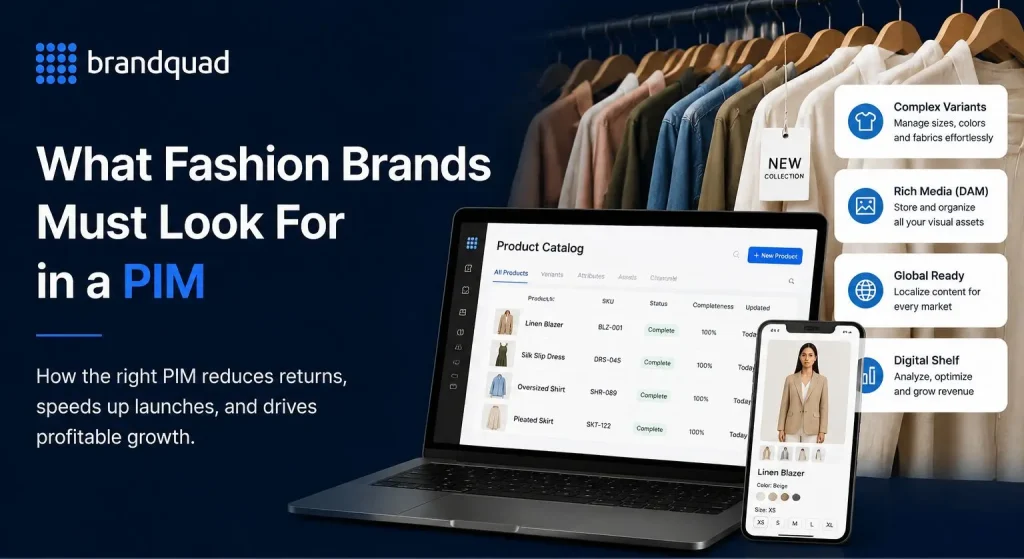
For growing fashion brands, the root cause of these returns — and the primary bottleneck preventing faster seasonal collection launches — is fragmented product data. Generic software and spreadsheets simply cannot handle the speed of fashion drops, complex sizing variants, and the massive volume of visual media required to sell clothing online. To scale effectively, protect margins, and distribute flawlessly to both D2C channels and wholesale retail partners, fashion brands require a specialized Product Information Management (PIM) system.
What Fashion Brands Must Look For in a PIM
When evaluating data infrastructure, fashion brands cannot settle for generic retail solutions. The apparel industry has highly specific operational needs. Here is exactly what brands must demand from their software:
- Complex Variant Management: Unlike simple consumer goods, fashion catalogs rely entirely on parent-child hierarchies. A PIM must seamlessly manage a single “parent” style (like a jacket) across dozens of “child” variations in size, colorway, and fabric, without requiring redundant manual data entry.
- Integrated Digital Asset Management (DAM): Fashion is deeply visual. Your software needs to handle high-resolution lookbooks, catwalk videos, and technical imagery, keeping them strictly organized by SKU to ensure the right image is always paired with the right product.
- Omnichannel Localization & AI Readiness: Selling cross-border means managing different languages, currency conversions, and platform-specific size mappings. Furthermore, as AI shopping bots begin to execute proactive searches for consumers, a PIM must perfectly structure this data so these autonomous agents can “read” and recommend your products.
- B2B and Wholesale Distribution: If your brand sells through wholesale distributors, the PIM must act as a central hub to securely distribute accurate line sheets, compliance data, and media directly to your retail partners.
Brandquad PXM: Built for the Realities of Fashion Retail
At Brandquad, our expertise is built on solving these exact operational bottlenecks. We recognize that mid-sized fashion businesses and SMBs are often trapped between rigid, expensive legacy software or entry-level tools that collapse under the weight of complex apparel catalogs. That is why we built Brandquad not just as a PIM, but as a complete, easy-to-use Product Experience Management (PXM) ecosystem tailored to help your brand scale effortlessly.
Here is how Brandquad provides exactly what fashion brands need:
- Flexible Attribute Modeling for Variants: We are a user-friendly platform designed to empower business users. Our model perfectly supports complex product variants with deep attribute inheritance.This allows your brand to enter the core parent data once, instantly cascading it to all variants and eliminating thousands of hours of manual entry.
- Built-In DAM Engineered for Fashion: Marketing teams can store terabytes of visual data in our natively integrated DAM. Our system utilizes automatic linking rules to tie every lifestyle image or video directly to the correct product via SKU. Furthermore, our AI instantly extracts the top 5 hex colors from your product photography to automatically generate color swatches for your catalogs. You can also dynamically export images – resizing, cropping, or adding specific background colors – without permanently altering your high-resolution files.
- Custom Channels & AI Discovery: We integrate seamlessly with any system in your tech stack, including complex ERPs like SAP and Oracle. Every export channel can be set up with custom calculations tailored specifically to a regional market’s requirements. By perfectly structuring your data and pushing it via native connectors to Shopify, Amazon, and global marketplaces, we ensure your brand is optimized for both traditional search and emerging AI shopping bots.
- 3x Faster Supplier Data Onboarding: Launching seasonal collections requires gathering massive amounts of data from external manufacturing partners. Brandquad’s Supplier Portal allows manufacturers to upload data directly into your standardized templates, accelerating data collection by 3x. To further eliminate manual entry, our AI scans attached PDFs (like sustainability certificates or care instructions) and automatically maps those characteristics directly into the product attributes.
- Public Catalogues for Wholesale Sharing: Distributing data to external partners is effortless. Our no-code Public Catalogues allow you to build secure, easily accessible hubs where internal teams and B2B retail partners can log in, save favorites, and download precise product data in their required formats.
- Digital Shelf Analytics (DSA): What transforms us from a PIM into a true PXM ecosystem is our integrated DSA. We close the content quality loop by providing automatic compliance monitoring and competitor tracking. You can instantly see if your products are priced correctly or if a retailer altered your brand messaging on the digital shelf.
- Accessible Pricing for SMBs to Enterprises: We believe enterprise-grade data infrastructure should be accessible. Brandquad offers a highly competitive basic plan starting at just €500/month (comparable to basic entry-level tools), which scales based on your exact infrastructure costs.
A specialized PIM is no longer an optional marketing tool; it is the foundational infrastructure required to lower return rates, launch faster, and conquer the digital shelf. By consolidating your data into a single, intelligent ecosystem, your team can stop wrestling with spreadsheets and start focusing on growth.
Ready to transform your fashion catalog? Stop letting fragmented data crush your margins. Book a demo to know more about how our Product Information Management (PIM) and Digital Shelf Analytics (DSA) modules can empower your brand.